Home › FAQ
Las Vegas water arrives from Lake Mead at a hardness most of the country never sees, and the answers below follow from that: what it does to fixtures and water heaters, and what softening actually changes.
If your question is not here, call and ask — we answer the phone.
For every price on one page, read the water softener cost in Las Vegas guide: what each job class runs, what moves an estimate, and what a written quote should show.
Common questions about Las Vegas water
How do I know if I have a problem?
Spots on the glassware that will not wash off, soap that never quite lathers, a kettle that scales in weeks, skin that feels tight after a shower — hard water announces itself in small ways long before it damages anything.
Is Las Vegas tap water hard?
Las Vegas tap water is hard. The valley draws about 90% of its water from Lake Mead via the Colorado River, and the Las Vegas Valley Water District reports hardness around 17 grains per gallon (291 mg/L) — very hard by USGS classification. It is safe to drink; the problem is scale and spotting.
How much does a water softener cost in Las Vegas?
Most whole-home installations run $1,500 to $4,500 installed, depending on system size, type, and whether new plumbing or a drain line is required.
Salt-based or salt-free for water this hard?
Salt-based removes hardness; salt-free only reduces scale and leaves the minerals in the water. On 17-grain water, most households wanting genuinely soft water choose salt-based.
Why did hard water come back even though the tank is full of salt?
Usually a salt bridge — the salt has crusted into an arch with empty space beneath, so no brine is produced. Push a broom handle down through the salt; if it hits a hard shelf, that is the cause.
Will a softener make my water taste better?
Not really. Softening removes hardness minerals. Taste and odor complaints usually come from chlorine and dissolved solids, which need filtration or reverse osmosis.
Is softened water safe to drink?
Softened water is safe to drink. Ion exchange adds a small amount of sodium — roughly proportional to the hardness removed. Households on strict sodium restriction can use potassium chloride instead, or add reverse osmosis at the kitchen tap.
Do I need a permit?
Most straightforward replacements do not, but new plumbing, drain work, or exterior installations can. We tell you before work starts if a permit applies.
How long does a water softener last?
Eight to twelve years for the resin on valley water, and often longer for the tank and valve with maintenance. Very hard water shortens resin life compared to national averages.
What happens if I go ahead?
What installation day looks like, and what maintaining a softener actually involves.
How long does installation take?
Two to four hours when a softener loop already exists. Homes needing a tie-in at the main or a new drain run usually take most of a day.
How often do I add salt?
Most valley households refill every four to eight weeks. Larger families and higher usage regenerate more often.
What if my softener is leaking right now?
Turn the unit to bypass — the valve on the plumbing behind the tank — so water routes around the system. If you cannot find it, shut off the main, then call us for same-day service.
Do you service systems you did not install?
We service systems you did not install, all common residential brands. We will tell you honestly when a repair is not worth it.
Still deciding what you need?
| System | What it does | Maintenance | Best for | Installed cost |
|---|---|---|---|---|
| Salt-based softener | Removes calcium and magnesium by ion exchange | Add salt every 4–8 weeks | Very hard valley water — the default here | $1,500–$3,500 |
| Salt-free conditioner | Alters minerals so they scale less; hardness remains | Little to none | No-salt households, milder needs | $1,000–$2,500 |
| Whole-house filtration | Reduces chlorine taste, odor, and sediment | Media or cartridge changes | Taste and smell complaints | $1,000–$4,000 |
| Reverse osmosis | Removes dissolved solids at one tap | Filter changes about yearly | Drinking and cooking water | $300–$1,200 |
Read more on installation, repair, or whole-house filtration, or see all services and service areas.
What should you do first if something seems wrong?
- Check the bypass valve. If it was left in bypass after service, untreated water is going straight to the house. This is the single most common "my softener stopped working" cause.
- Push a broom handle through the salt. A hard shelf with space underneath is a salt bridge.
- Look for standing water in the brine tank. More than a few inches usually means an injector or drain restriction.
- Check the display. A blank screen points to power or the control board.
Two of those four you can fix yourself in ten minutes.
How much does hard water actually cost you?
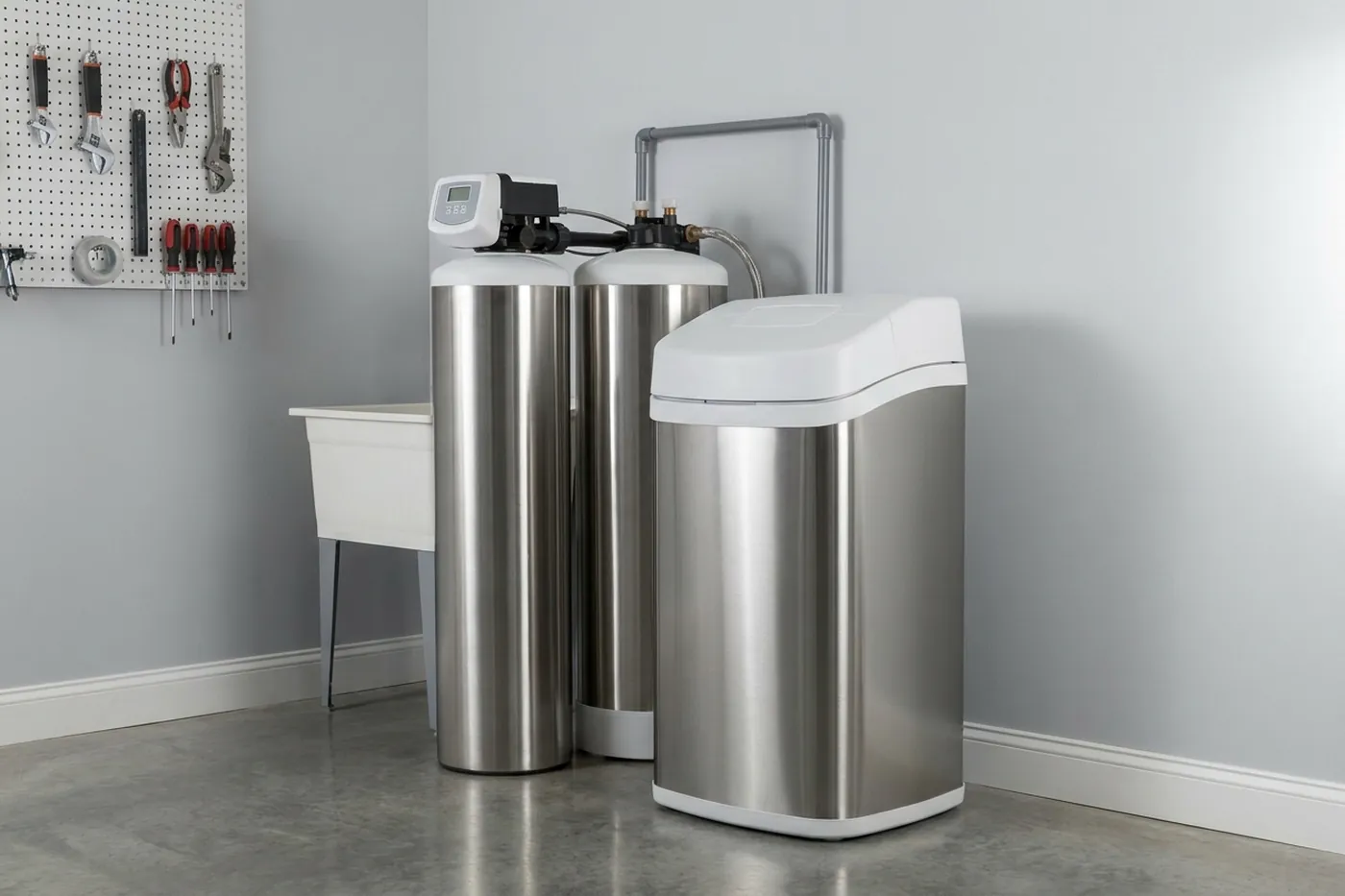
Scale shortens water heater life, reduces heating efficiency as it coats the element or tank bottom, and puts wear on dishwashers and washing machines. You also use noticeably more soap, shampoo, and detergent because none of it lathers properly in 17-grain water. None of that is catastrophic on its own; it accumulates.
Get a free Las Vegas estimate
Tell us what you're seeing at your fixtures and we'll recommend a system sized to your home. We call back the same business day.